
Jonathan Wilson’s World Cup Diary
A day in the life of a reporter on the road, growing his Substack, and contending with the Americanization of the world’s game


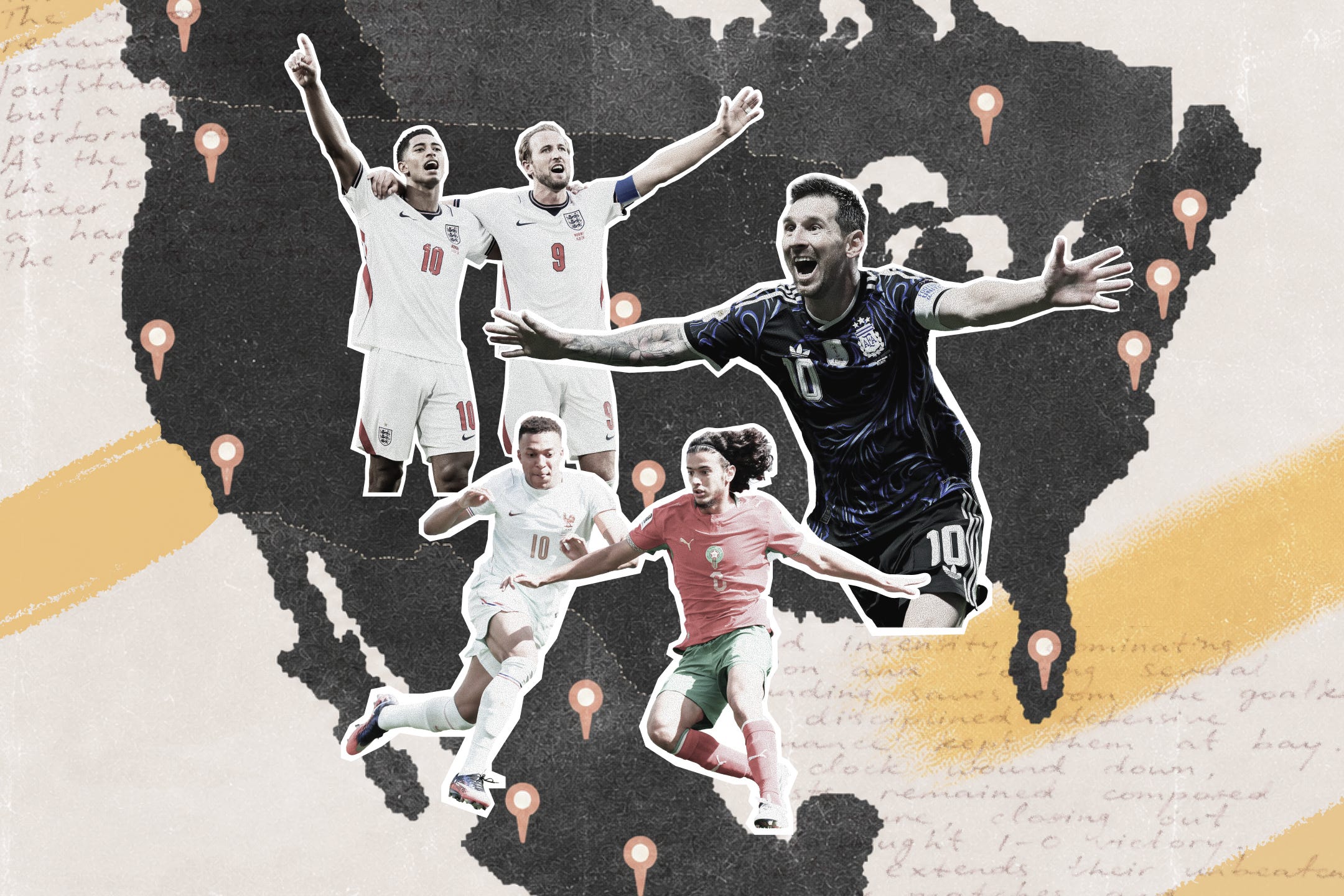
We caught up with veteran British soccer writer, podcaster, and historian of the game Jonathan Wilson on the eve of his sixth World Cup final. Over the past six weeks, he’s been all over the map, filing from Mexico City, Guadalajara, Houston, and Boston for The Guardian, Bloomberg, the Paris Review, and more, while bringing literary dispatches and wry analysis to his own newsletter Wilson’s World (of football). We asked him to document the day he covered the Spain-France semifinal in Dallas and chatted with him about his Substack strategy, how he expanded his subscriber base by 40% over the course of the tournament, and his reckoning with the strange atmosphere at World Cup 2026.
Your sixth world cup! How many matches did you get to this time around?
Fifteen, I think. Maybe 16. I did three in Mexico City, three in Guadalajara, two in Monterrey, so that’s eight. I did four in Dallas, two in Houston, one in Boston. So 15 total!
I also loved your dispatches from the games you caught along the way: watching from hotel bars, or restaurant patios, or catching the Germany-Paraguay penalty shootout at an airport Chili’s.
I wasn’t even in it! I was outside the Chili’s. I was rushing through security to see the end, obviously had to make my flight, and I could see the screens. I was like, “Okay, I can just go over there and watch.” There were maybe about a dozen people there when I got there, and I got there at about 117 minutes. By the end of the penalties there were 60, 70, 80 people standing there. If you’d been selecting the most diverse group of people you could have found, you couldn’t have created a better one. There were a couple of security staff, a pilot, a couple of cleaners, a bloke in a Swiss shirt, loads of people with Mexican shirts, babies in pushchairs, old people in wheelchairs. People who clearly knew exactly what was going on, people who said, “I don’t understand this. What happens next?” It was the great World Cup moment of everybody coming together to watch this exciting denouement of the game.
How does that compare to being in the stadium?
In the stadium you get a much better feel for the game. It’s almost like a native speaker of a language. You have to start speaking a language before you’re 6 or 7 to really understand it. Football’s exactly the same. If you start going to games when you’re 4 or 5, you can smell what’s going to happen. You don’t know why, you can’t explain it, but it’s a very common thing for people who have been going from that age. That sense for a shift in emotional momentum—you get a much better feel for that in the stadium.
Fans at World Cups are not the same as fans in club games. It’s a much more touristy, jolly, happy vibe. There’s a lot of anger at club games. The Spain-France game was weirdly unanxious. Spain was so obviously better that everybody sort of accepted their fate. There was no greater roar to try and rally the French. The French have a slightly strange reputation for not really being a football country. It was only after they won the World Cup in ’98 that the average crowd in the French first division went above 20,000 for the first time. I think it has changed over the last nearly 30 years, but certainly in the late ’90s there was a perception that the French didn’t really know whether they preferred football, rugby, or cycling. You see a self-conscious wackiness about French fans rather than the raging anger you get from England fans.
You’ve written quite a bit about the atmosphere inside the stadiums this time around: the DJ sets, the cheerleaders, the QVC-style entertainment before kickoff. Did this World Cup feel particularly American?
It’s so relentless. From three hours before kickoff, they’re just blasting noise at you and trying to sell you stuff. Things like Dance Cam and Kiss Cam and just showing fans. If that was England, people would be making rude gestures at the camera. There’s no way they’d just be grinning and waving and going along with it. That anarchic attitude the English fan has just doesn’t seem to exist anywhere else, for better or for worse. I do wonder if it’s because everything’s so expensive here that people think, “I’ve spent $5,000 on this. I’ve got to at least convince myself I’m having a good time.” Maybe sticking two fingers up at the camera isn’t the best way to do that.
Did you go into the tournament with a Substack strategy, or did you figure it out as you went?
A bit of both. I had a plan pre–World Cup that I’d do two pieces a week and one of them would be paid. I realized during the World Cup there’s way more to say than that. I deliberately didn’t take on too much freelance work so that ideas I had that didn’t work for The Guardian I could put on Substack. It has worked. My subscriber base has gone up by about 40%, which is a huge increase. There’s a freedom there that I can write to whatever length I want. A lot of it was fumbling around, seeing what worked.
The thing that got me the most new readers was when the Folarin Balogun decision was made, when his suspension for the red card was overturned. I was on a bus between Houston and Dallas, saw the news break on my phone, and thought, “I’ve actually got an hour and a half here. I can just write something, get it out there.” Because it was such an obviously disgraceful decision, I was writing with a real degree of anger and frustration. There’s also a historical precedent for this, in 1962, which I knew about from doing the book [The Power and the Glory], so I was able to bring that in. That combination of historical knowledge plus opinion, that’s when I write best anyway, when I care about something but there’s also some history behind it. It was a story a lot of people were interested in, and I was able to get it out quickly. I must have got a dozen, maybe 20 paid subscribers off the back of that, which for one piece is great.
Why did that piece end up on your newsletter rather than The Guardian?
The Guardian has people who cover the sports politics side of things. It’s not totally impossible they’d have asked me to do it, but they also knew I was on a bus. And they have to pay me for every piece, so they’re quite careful about what they give me. There’s a financial incentive for them to use their contracted staff rather than me.
Would you want to be full-time at The Guardian?
I was full-time at the Financial Times for three years, and it came to an end, and I’ve been freelance ever since. I like the freedom. I like the fact that basically the harder I work, the more money I get. I like that I can do a huge range of different things. I can do the books when I feel like doing the books. I can do podcasts, documentaries. It’s very good to have The Guardian there, and I’m very grateful that they’ve been quite open to me having one foot in the camp and one foot outside. I do a match a week for them and a column a week, so that’s a basic structure to build around. I now do a newsletter for the U.S. market as well. If they wanted me to move fully on staff and give up everything else, the package would have to be extraordinary. People think you have security if you have a staff job, but if you lose that job, you don’t have a safety net. If you’ve got seven or eight different strings holding you up and one of them’s cut, there are six or seven strings still holding you up, and that’s not a bad position to be in.
How significant is the Substack string, financially?
I’ve been running my Substack for 18 months. Pre–World Cup it was a nice way to make a bit of beer money on the side. Now it’s a little bit more serious. It’s certainly not enough to live on, but I’m not devoting 100% of my time to it. It’s a nice contingency from a financial point of view. It’s also useful to have an outlet for stuff I want to write that I don’t have other places to write, and I can make money out of it. It’s nice to know that were something to go wrong with The Guardian, I’m not going to be destitute. Probably if The Guardian did go wrong and I devoted more time to it, those [Substack] numbers would go up and it would be a viable salary.
How do you decide what goes behind your paywall?
Pre–World Cup it was simple: Monday is free, Thursday is paid, nothing more complicated than that. During the World Cup I was essentially going alternate free, paid, free, paid. But some things, like the playlists I did with Peter Frankopan, the historian, there’d be no point putting that behind a paywall. That’s just a bit of fun. Equally the piece I did going through the most significant goal scored in each minute of a World Cup game—why would you put that behind a paywall? It’s free or it’s nothing. I see that as a way of just getting a bit of traffic. But if there’s a properly argued-through piece, if you give people three or four paragraphs, hopefully that intrigues them enough that they’ll pay for the rest of it. A bit of history, you entice them in with the first few paragraphs and hopefully they get the payoff after that.
As to what my paid subscribers look like, I assume they’re people who know me through my other writing, through my podcast and my books, who just want a bit more. The Substack is at times a bit more personal, a bit less formal. Maybe they feel it’s a bit closer to knowing me rather than being filtered through various editors and newspaper editorial practices. I would imagine they’re people not dissimilar to me who’ve got a quirky interest in football history but also want informed opinion about mainstream stuff.
You mentioned that there’s a sensibility you develop if you start watching the game young. Were you one of those kids?
I was. Sunderland was my team; it’s still my team. My dad was a master at making sure that whatever we were doing on a Saturday afternoon, we were by a radio or the TV by 4:40 to get the results coming in. I went to my first game in October 1982, when I was 6. When I was in my mid-teens, I would go to every Sunderland home game, most of the away games, and often Newcastle home games as well. Looking back, it seems insane. At the time, football in Britain was still quite dangerous, and my parents were just saying, “Yeah, make your own way,”—a seven-hour trip to Swindon and back—“just make sure you try and get back by midnight.” But my dad had done it when he was a kid.
Do you remember how much it cost to go to those matches back then?
Almost nothing. It was £2.50 if you were under 16 to get in. And for the away games, there was a fanzine, and the editor would give us a lift as long as we sold the magazine for him. We’d actually make money! He’d pay us £10 to sell the magazine, we’d get the free lift, and he’d often pay for our tickets as well.
Jonathan Wilson’s World Cup Diary—Tuesday, July 14
I recognise this is not something that’s going to get me a lot of sympathy. Covering the World Cup as a journalist is a great privilege, obviously. I’ve been to 15 matches at this tournament and been paid to do it. It’s not really something to complain about, not even when every day seems to bring fresh problems with wi-fi and travel. But by this stage of the tournament, in my sixth week away from home, I’m exhausted.
After covering Spain’s semi-final win over France, I went to a Mexican restaurant in Dallas with a colleague. We both ordered tacos, at which the waiter gleefully told us it was Taco Tuesday, so you got four for $8. Both of us had the same reaction: “Today’s Tuesday?” After so long on the road, neither of us had any idea, although we both had the same sense that it felt Thursdayish, which I think just means that we’re aware the end is close, just not quite as close as we might like.
In that six weeks, I haven’t had a day off. I think there have been two days when I’ve had more than six hours sleep. Eating well is extremely difficult; there’s a lot of meals grabbed in airports and stadium media centres. Exercise tends to be whatever you can manage in your hotel room.
I’m freelance. I work mainly for the Guardian, and my schedule is largely determined by them. I covered Mexico in the group stage, then Texas in the round of 32 and the last 16 and headed up to Boston for the quarter-final. After that I was supposed to be in New York for the last 10 days, watching the remaining six games on television and working on Football Weekly, the Guardian’s very much daily-during-the-World-Cup football podcast. But I also co-host two podcasts—Libero and It Was What It Was—and, since January last year, I’ve had my Substack.
This week has been unusually challenging. I was in New York at the weekend and hoped to have enough time on the Sunday, when there were no World Cup games, to go to the Mets v Red Sox. But tournaments very rarely give you that opportunity. The Guardian were able to secure three passes for each semi-final, so asked me to fly down to Dallas on Monday for Spain v France. That meant having to pull out of the baseball to finish writing the newsletter I always write for the Guardian’s US edition that goes out on Monday morning and to at least start work on a feature about Lionel Scaloni, the Argentina manager. I sorted out flights and hotel and, midway through the afternoon, went out to Bryant Park to meet an Irish journalist to record a section of a podcast previewing the England v Argentina game. That evening, I’d arranged to meet the Guardian’s US sports editor, whom I’d known years ago in London.
My flight on Monday was from Newark at 12:20. But I had an early start: before I set off for the airport, I had to record a podcast for Sky, speak to a journalist from Reuters, and appear on a BBC radio show. When I got to the airport, I had a bagel and coffee and finished my Scaloni piece. Only when I’d filed did I check my flight, and found it was delayed by four hours. Within 10 minutes, it was four and a half hours late. I checked with American Airlines staff and they suggested rerouting via Charlotte. The flight from Charlotte to Dallas was also delayed because of storms in Texas, then there was a lightning strike in North Carolina, and then, just as we were about to take off, somebody vomited, which meant he had to get off and cleaners had to get on. In the end, I was about seven hours late getting to Dallas, having eaten nothing from the bagel to a bag of Doritos in the hotel bar 13 hours later.
But it wasn’t just food I’d missed; I hadn’t answered any emails from finally getting on the plane at around 6pm Eastern Time. Which meant getting up at 6:30am to go through my inbox, have breakfast, and go through the edits to a piece I’d written for Bloomberg before catching the media shuttle to the stadium at 10am. Kick-off wasn’t till 2pm, but the drive takes around 40 minutes and there’s always stuff to sort out: expenses to file and last-minute research to do.
Since there were three of us at the game, I was writing a colour or analysis piece on France, while my colleagues did the match report and a separate piece on Spain. Given the way the game went, it was a relatively straightforward piece to write, so I was able to file 40 minutes or so after the final whistle and catch the first shuttle back. That could have meant an earlyish night after my tacos, except that the atmosphere had been very strange, so I decided to write a piece for my Substack about that, which happily filled in the time before another BBC interview at 10:15pm for the following morning’s Radio 4 Today programme.
And then, at 11pm, to bed, with the alarm set for 4:45am to get to the airport to catch an early flight to New York to watch the England v Argentina game there and record a podcast about it.
The rest of the week looks brutal, workwise, with five podcasts and a live show at the Bowery Ballroom on Thursday and a couple more podcasts and a column to write on Friday before the traditional journalists’ big meal out two days before the final. Everybody’s running on fumes, but that’s the nature of World Cups. It’s the way it’s meant to be.
 | A guest post by
|